

THE MANUAL LIBRARY
John Deere Bauer DB40, DB44, DB50, DB58, DB60, DB62, DB66, DB74, DB80, DB88, DB90 Planters Repair Manual (S/N: 000000 – 745100)
$49.00
Documentation Specifications
| Manufacturer | John Deere |
| Applicable Model | DB40, DB44, DB50, DB58, DB60, DB62, DB66, DB74, DB80, DB88, DB90 |
| Machine Series | Series DB |
| Serial Number Range | (SN between 740101 – 745100) |
| Machine Type | Planter |
| Documentation | Repair Technical Manual, Operation and Test Manual |
| Publication Reference | TM2091 & TM116219 |
| Language | English |
| Format |
Manuals Provided
| Repair Technical Manual | 396 Pages |
| Operation and Test Manual | 2421 Pages |
Brief Description of the Manual
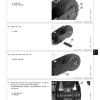
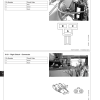
This service reference brings together fault diagnosis, electrical and control systems, hydraulic systems and transmission and drive systems. It is arranged to help the reader locate the relevant system information and prepare for the work described in that section. The section and subsection headings provide a route to the individual components and tasks within that coverage. Use their sequence to locate the subject being investigated, then follow the instructions and applicability notes associated with the selected section. Separate contents groups remain attached to their own document headings.
Table of Content
All contents headings available in the supplied source are retained below, in source order.
Table of content (diagnostic and test technical manual – TM116219)
- Section 210 — general information
- Group 05B — safety
- Group 05C — general information
- Group 05D — references
- Section 211 — diagnostic trouble codes and warnings
- Group 10A — PM1 diagnostic trouble codes
- Group 10B — PM2 diagnostic trouble codes
- Group 10C — PA1 diagnostic trouble codes
- Group 10D — SNC diagnostic trouble codes
- Group 10E — warnings
- Section 212 — observable symptoms and system diagnostics
- Group 40A — electrical
- Group 70A — hydraulics
- Group 80A — pneumatic downforce air
- Section 240 — electrical
- Group 10A — calibration procedures
- Group 20A — theory of operation
- Group 30A — schematics – frame
- Group 30B — schematics – CCS
- Group 30C — schematics – CAN bus
- Group 30D — schematics – seed monitoring
- Group 30E — schematics – variable rate drive
- Group 30F — schematics – row command
- Group 30G — schematics – enhanced monitoring pneumatic downforce
- Group 30H — schematics – swath and rate control
- Group 50A — diagnostics – frame
- Group 50B — diagnostics – CCS
- Group 50C — diagnostics – CAN bus
- Group 50D — diagnostics – seed monitoring
- Group 50E — diagnostics – variable rate drive
- Group 50F — diagnostics – row command
- Group 50G — diagnostics — enhanced monitoring pneumatic downforce
- Group 50H — diagnostics – swath-rate control
- Section 245 — electronic control units
- Group 10A — SeedStar main control unit PM1 addresses
- Group 10B — SeedStar secondary control unit PA1 addresses
- Group 10C — SeedStar XP meter master control unit PM2 addresses
- Section 249 — electrical component information
- Group 40A — X001 – X099
- Group 40B — X100 – X199
- Group 40C — X200 – X299
- Group 40D — X300 – X399
- Group 40E — X400 – X499
- Group 40F — X500 – X599
- Group 40G — X600 – X699
- Group 40H — X700 – X799
- Group 40I — X800 – X899
- Group 40J — X1300 – X1399
- Group 40K — X2300 – X2399
- Section 270 — hydraulics
- Group 10A — proportional flush
- Group 10B — calibration procedures
- Group 20A — theory of operation
- Group 30A — schematics – frame
- Group 30B — schematics – CCS
- Group 50A — diagnostics – frame
- Group 50B — diagnostics – CCS
- Section 280 — pneumatic downforce air
- Group 10A — calibration procedures
- Group 20A — theory of operation
- Group 30A — schematics
- Group 50A — diagnostics
- Section 289 — pneumatic downforce air component information
- Group 40A — accumulators
- Group 40B — sensors
- Group 40D — check valves
- Group 40F — filters
- Group 40G — assembly groups
- Group 40M — motors
- Group 40P — pumps
- Group 40R — reservoirs
- Group 40S — switches
- Group 40V — valves
- Group 40X — couplers or diagnostic receptacles
- Group 40Y — solenoid valves
Table of content (technical manual – TM2091)
- Section 10 — general information
- Group 05 — safety
- Group 10 — lubricants
- Group 15 — general information
- Section 20 — vacuum system
- Group 05 — vacuum meter system
- Section 25 — central commodity system
- Group 05 — seed tanks and manifolds
- Group 10 — seed delivery hose
- Group 15 — central commodity system fan
- Group 20 — polyethylene tank repair
- Section 30 — planting units
- Group 05 — maxemerge™ plus/maxemerge XP vacuum seed metering mechanisms
- Group 10 — maxemerge™ plus/maxemerge XP plateless seed metering mechanisms
- Group 15 — pro-series™ XP vacuum seed metering mechanisms
- Group 20 — seed openers
- Group 25 — closing wheels
- Group 30 — insecticide/herbicide meter
- Group 35 — coulter
- Group 40 — down force springs
- Section 35 — hitch and frame
- Group 05 — repair and welding
- Section 50 — drives
- Group 05 — specifications
- Group 10 — drive wheels
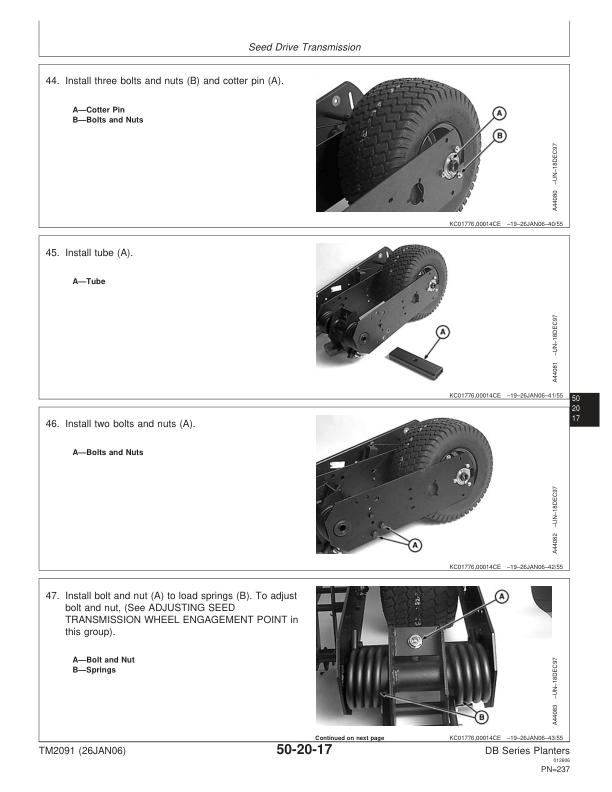
- Group 20 — seed drive transmission
- Group 30 — drillshaft
- Group 40 — half-width disconnect
- Group 45 — variable rate drive
- Section 70 — hydraulics
- Group 05 — motors
- Group 10 — miscellaneous
- Section 240 — electrical diagnosis and test
- Group 05 — how to use this diagnostic information
- Group 10 — solenoid sequence table
- Group 15A — auxiliary power outlet diagnostics
- Group 15B — CCS seed delivery agitator diagnostics
- Group 15C — CCS low tank warning diagnostics
- Group 15D — CCS planter raise/lower diagnostics
- Group 15E — CCS seed delivery fan diagnostics
- Group 15F — CCS tank fill lights diagnostics
- Group 15G — field raise-lower diagnostics
- Group 15H — half width disconnect diagnostics
- Group 15I — lighting overall diagnostics
- Group 15J — machine fold-unfold diagnostics
- Group 15K — marker raise-lower – manual mode diagnostics
- Group 15L — tongue latch diagnostics
- Group 15M — tongue lift diagnostics
- Group 15N — transport lift diagnostics
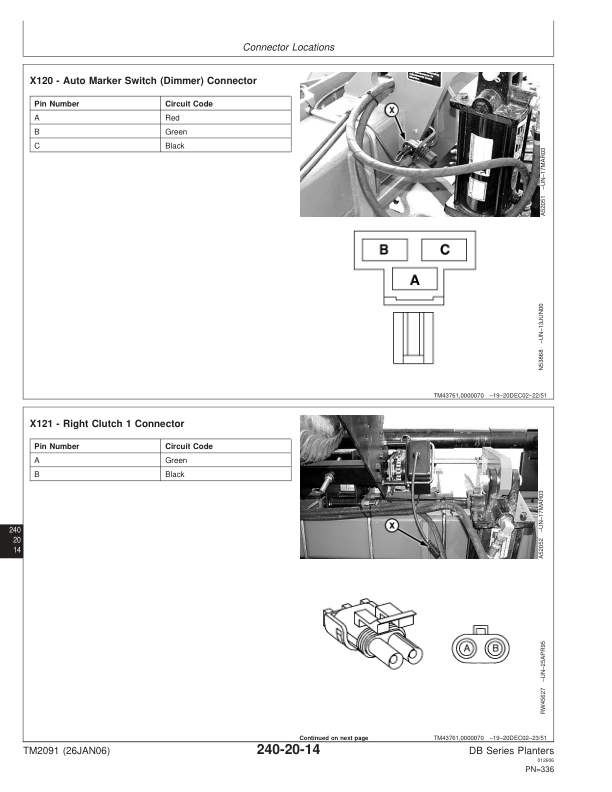
- Group 20 — connector locations
- Section 270 — hydraulic diagnosis and test
- Group 05 — general information
- Group 15A — CCS seed delivery fan motor diagnostics
- Group 15B — field raise – lower diagnostics
- Group 15C — fold-unfold diagnostics
- Group 15D — left marker diagnostics
- Group 15E — right marker diagnostics
- Group 15F — tongue latch diagnostics
- Group 15G — tongue lift diagnostics
- Group 15H — tongue lift (independent) diagnostics
- Group 15I — transport lift diagnostics
- Group 15J — wing wheel transport diagnostics
- Group 20 — hydraulic components
Manual Additional Info
The diagnostic material and the listed testing or reference sections provide complementary ways to approach a problem: one identifies the area to investigate, while the other helps the reader locate the supporting checks or information. Keep the contents groups separate when selecting instructions. A topic listed for one document does not establish the same coverage in every companion document. Keep the named configuration and document boundaries in view when following that route; a section heading describes its own coverage and does not extend it to every model or optional arrangement.
Be the first to review “John Deere Bauer DB40, DB44, DB50, DB58, DB60, DB62, DB66, DB74, DB80, DB88, DB90 Planters Repair Manual (S/N: 000000 – 745100)” Cancel reply
Related manuals and categories
Other manuals in the same manufacturer and machine category. Check each listing for its model, serial range and edition.
- More John Deere Planter ManualsJohn Deere Small Frame Planter Precision Upgrade Kit Diagnostic Repair Technical Manual (TM171019)↗
- More John Deere Planter ManualsJohn Deere 3100FT Series Planter Repair Technical Manual (TM811419)↗
- More John Deere Planter ManualsJohn Deere 1207, 1209, 1211, 1213 Planters Service Repair Manual (TM810419)↗
Reviews
There are no reviews yet.